
Soccer IQ for kids: what it is and how to build it
A plain guide for parents. Updated October 15, 2026.
The short answer
Soccer IQ is how well a player makes decisions before the ball arrives. They scan to see where teammates, opponents and space are. They choose what to do. Then they act. Parents help most by giving their child more real games, and by asking one open question after the game instead of giving instructions during it.
What soccer IQ is
Soccer IQ is not a school test. It is game sense. A player with good soccer IQ seems to have more time, because they have already decided what to do when the ball comes.
It has three parts:
- Scan. Look around before the ball arrives. Where is my teammate? Where is the defender? Where is the space?
- Choose. Pick one option: pass, dribble, shoot, or keep the ball.
- Act. Use your technique to do it, with the right speed and weight.
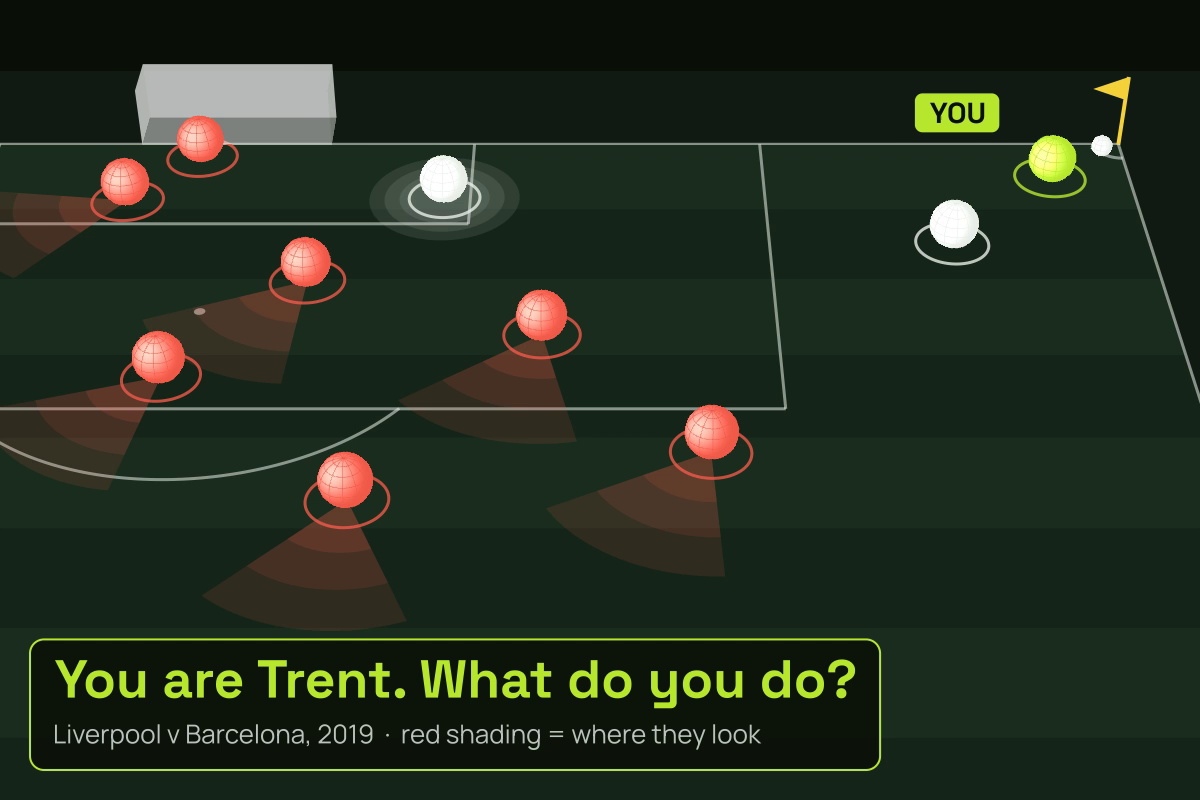
Here is one real example. In the 2019 Champions League semi-final, Liverpool played Barcelona at Anfield. Trent Alexander-Arnold took a corner quickly while the Barcelona defenders were looking away. Divock Origi scored from it. The corner taker saw that the defenders were not ready, chose to play at once, and passed to a free teammate.
How parents can help without coaching from the sideline
The sideline is where parents can do the most harm to decisions. If you shout “pass!” or “shoot!”, your child learns to listen to you instead of reading the game. Cheer effort. Stay quiet about choices.
The car-ride question
Wait until you are in the car, and wait for your child to be ready. Ask one question, then listen:
- “What did you see before you got the ball?”
- “What else could you have done?”
- “What would you try next time?”
Do not ask all three. Do not follow with advice. If your child does not want to talk, let it go. Try again after the next game.
Three other things that help
- More games, fewer queues. A small game like 4v4 gives many more decisions than a line for a cone drill.
- Play in different positions. Each position shows the game from a new angle.
- Watch one player. Watch a pro in your child’s position for ten minutes. Where do they stand? When do they look around?
For the UK version of this guide, with more on age and research, see how to improve your child’s football IQ. For home practice ideas, see how to help your child get better at football.
A 5-situation self-check
At the next match, watch for these five moments. This is not a score. It is a way to notice what your child already does, and what you could talk about later.
- 1
Before the ball arrives
Does your child look around before it reaches them, or only after the first touch? A quick look over the shoulder is the habit to notice.
- 2
On the ball under pressure
When a defender closes in, does your child have an idea before the pressure comes, or do they freeze and kick it away?
- 3
Off the ball in attack
When a teammate has the ball, does your child move into open space, or stand still and wait to be passed to?
- 4
After losing the ball
What is the first thing your child does? Chase, drop back, or stand and watch? None is always right. Notice the choice.
- 5
At a restart
At a throw-in, corner or free kick, does your child check where teammates and opponents are before it is taken?
Want to practise at home? Try our soccer IQ test: 10 game situations. Read it with your child and talk about each choice.
Where our game fits
We are building a Soccer IQ game for club and travel players. Your child sees a real match moment, makes the call, and then learns why. It is meant to sit beside real games, not replace them. It is still being built, so there is a waitlist.
When you join, you get one welcome email. After that we write only when early access opens.
Soccer IQ questions
What is soccer IQ?
Soccer IQ is how well a player reads the game and decides what to do. It covers where to look, where to stand, and when to pass, dribble, shoot or hold the ball. Coaches also call it game awareness, vision or decision-making. It is not the same as a school IQ.
Can soccer IQ be improved?
Yes, slowly. It grows with many real games, a habit of looking before receiving, playing different positions, and talking about decisions after matches. There is no quick fix, and no one can promise a result for one child.
How can parents help without coaching from the sideline?
Stay quiet during play and ask one open question later, for example in the car. “What did you see before you got the ball?” is a good start. Shouting instructions makes the decision for your child.
What age should kids start working on soccer IQ?
Any age can start with simple habits like looking around and playing small-sided games (fewer players a side, more touches). Decisions get harder as the field and the number of players grow, so ages 9 to 12 are a common time to focus on it.
Is there a soccer IQ test for kids?
Our 10-situation soccer IQ test shows common game moments with three choices each, then the answers and a short reason. It is for practice and talking together. It does not measure ability or predict a child’s future in the game.
Does soccer IQ matter more than skill?
They work together. Good technique helps a player carry out a decision. Good decisions help a player use their technique at the right time. Both can be built.
Updated October 15, 2026. Academy Parent is independent and not linked to any club, league or federation. The Liverpool v Barcelona example is from the 2019 Champions League semi-final, second leg.